Your new agents completed the training. They passed the assessments. They know the policies.
But what happens when they receive their first live customer call?
Can they locate the correct account while listening to the customer? Can they research an unfamiliar request without relying on their supervisor? Can they follow the correct procedures, complete the necessary account actions, and document the interaction accurately?
These are the skills that determine whether an agent can apply what they learned.
The challenge with customer service onboarding isn’t always a lack of information. Sometimes, it’s a lack of opportunities to practice using that information under realistic conditions.
If you want new agents to enter production better prepared, the training process must go beyond teaching what to do. It needs to include opportunities to demonstrate how to do it.
1. Stop Treating Training Completion as Proof of Readiness
Completing an LMS module confirms that an employee participated in or satisfied the requirements of a course.
It doesn’t necessarily confirm that the employee can execute the complete workflow independently.
For example, a trainee might correctly answer a quiz question about customer verification but struggle when a customer provides incomplete information during a mock call.
The knowledge is there. The practical application still needs work.
Before go-live, define what successful performance looks like for your team’s most common customer interactions.
Your readiness criteria might include:
- Completing customer verification correctly.
- Locating and interpreting account information.
- Using approved resources to research a request.
- Selecting the appropriate resolution.
- Completing required documentation.
- Recognizing when escalation is necessary.
These criteria provide a clearer picture of readiness than course completion alone.
2. Build Mock Calls Around Real Customer Problems
Not every customer call follows a predictable script.
Some customers forget important details. Others become frustrated. Account information may be incomplete, or the resolution may require multiple actions.
Training scenarios should reflect those realities.
Start with a routine customer inquiry. Then add one realistic complication, such as a missing account detail or an unexpected follow-up request.
The trainee must decide what information is needed, where to find it, and which steps to complete.
This transforms a simple conversation exercise into meaningful job practice.
3. Make Account Navigation Part of the Exercise
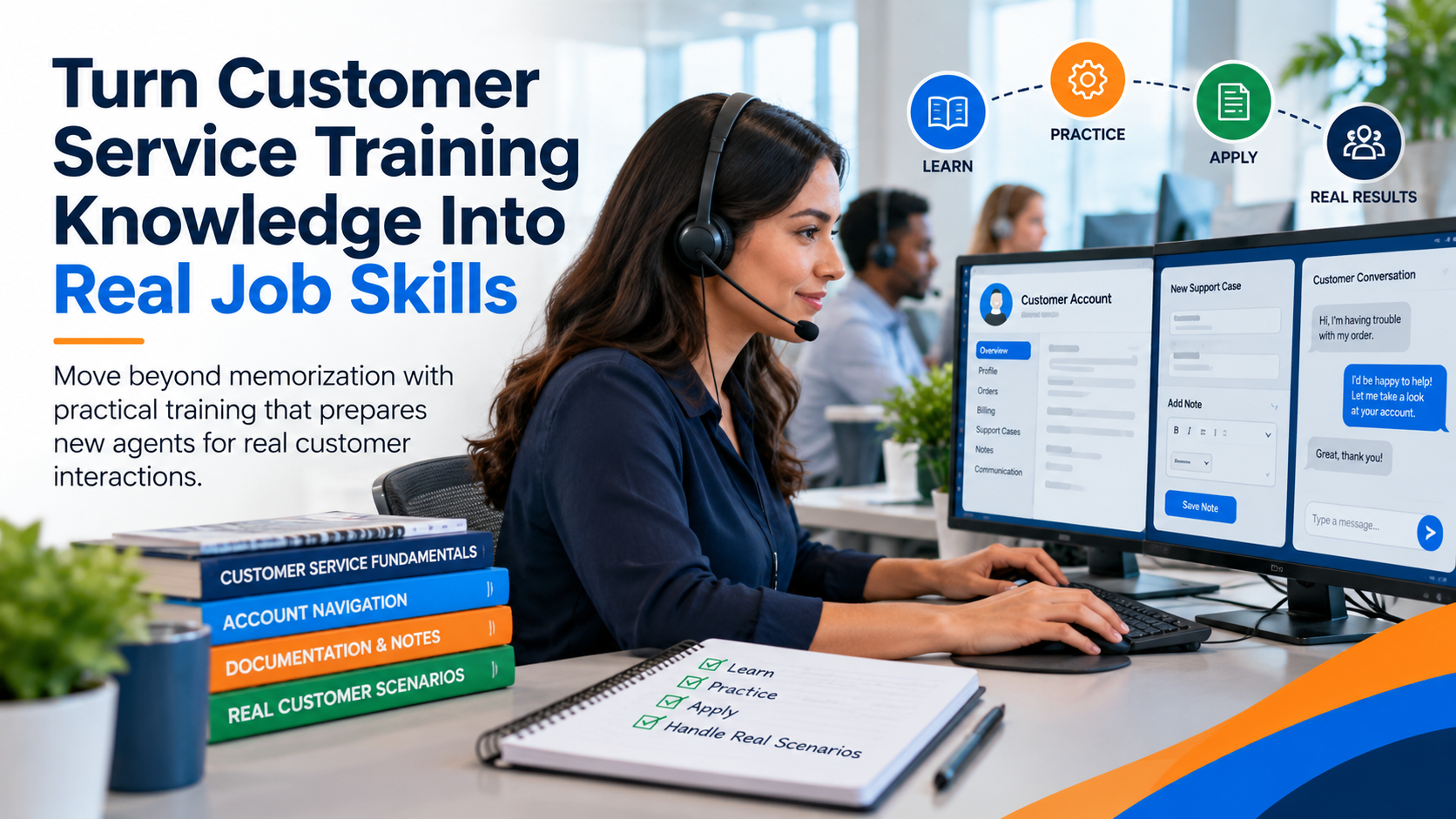
Agents often learn how to use a CRM through demonstrations.
But watching a trainer navigate a system isn’t the same as doing it independently.
Give trainees a fictional customer account and ask them to complete a specific task.
For example:
A customer calls because a previously submitted document isn’t reflected in their account.
The trainee must verify the customer, locate the account, search the relevant records, determine the correct next step, and document the interaction.
This exercise tests several skills simultaneously, just like a real customer interaction.
4. Evaluate Actions, Not Just Answers
A trainee saying what they would do is different from actually performing the task.
During mock calls, evaluate whether the trainee followed the required process, located the correct information, completed the action, and documented the outcome.
Use consistent scoring criteria so each trainee is measured against the same expectations.
When a trainee struggles, identify the specific skill involved. Was it navigation? Research? Decision-making? Documentation?
Then assign practice that addresses that skill instead of repeating the entire training module.
Don’t just explain the workflow. Make trainees practice it.
From verification to resolution, structured mock calls give your team a way to observe what new agents can actually do before go-live.

Build realistic practice without starting from scratch.
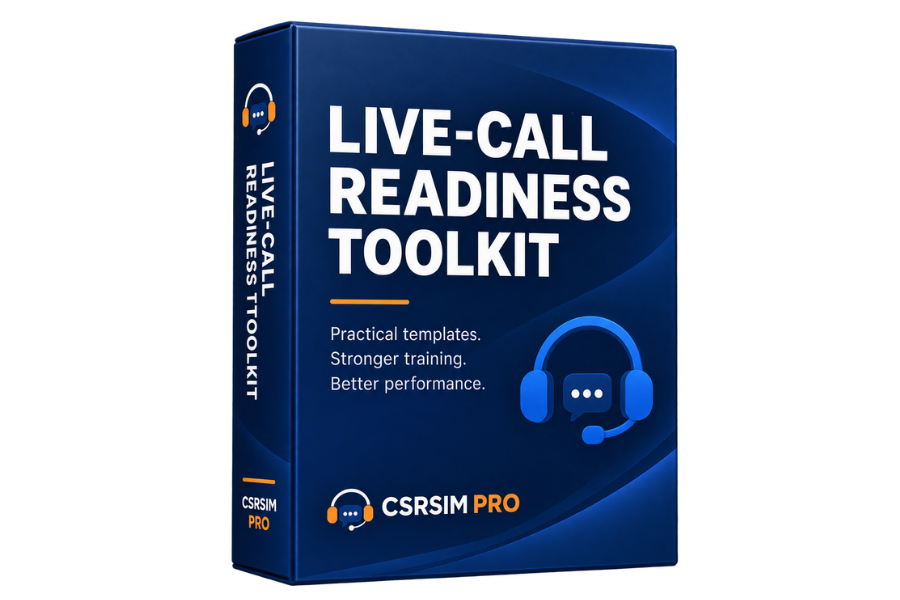
The Live-Call Readiness Toolkit includes mock call templates, verification and documentation checklists, trainee scoring tools, and AI prompts to help your training team turn knowledge into job-ready execution.
Explore the Live-Call Readiness Toolkit →5. Introduce a Readiness Check Before Go-Live
Consider giving every trainee a final scenario that combines the essential parts of a typical customer interaction.
The trainee should complete the scenario with an appropriate level of independence while the trainer observes.
Document strengths, errors, and skills requiring additional practice.
Readiness doesn’t mean an agent will never need assistance. It means the agent has demonstrated the foundational skills required for the work they’re authorized to perform.
Give Your Agents Practice Before They Face Production Pressure
The goal of onboarding shouldn’t be to move employees through training as quickly as possible.
It should be to prepare them to perform their responsibilities accurately, confidently, and with the appropriate level of independence.
That preparation takes structure.
The CSRSIM PRO Live-Call Readiness Toolkit helps trainers create realistic mock call scenarios, organize account navigation exercises, evaluate trainee performance, and review documentation using practical, reusable templates.
Instead of starting from a blank page, you can build your next training activity around a defined objective, a realistic customer situation, and measurable expectations.
Explore the Live-Call Readiness Toolkit and start creating more purposeful customer service practice before go-live.