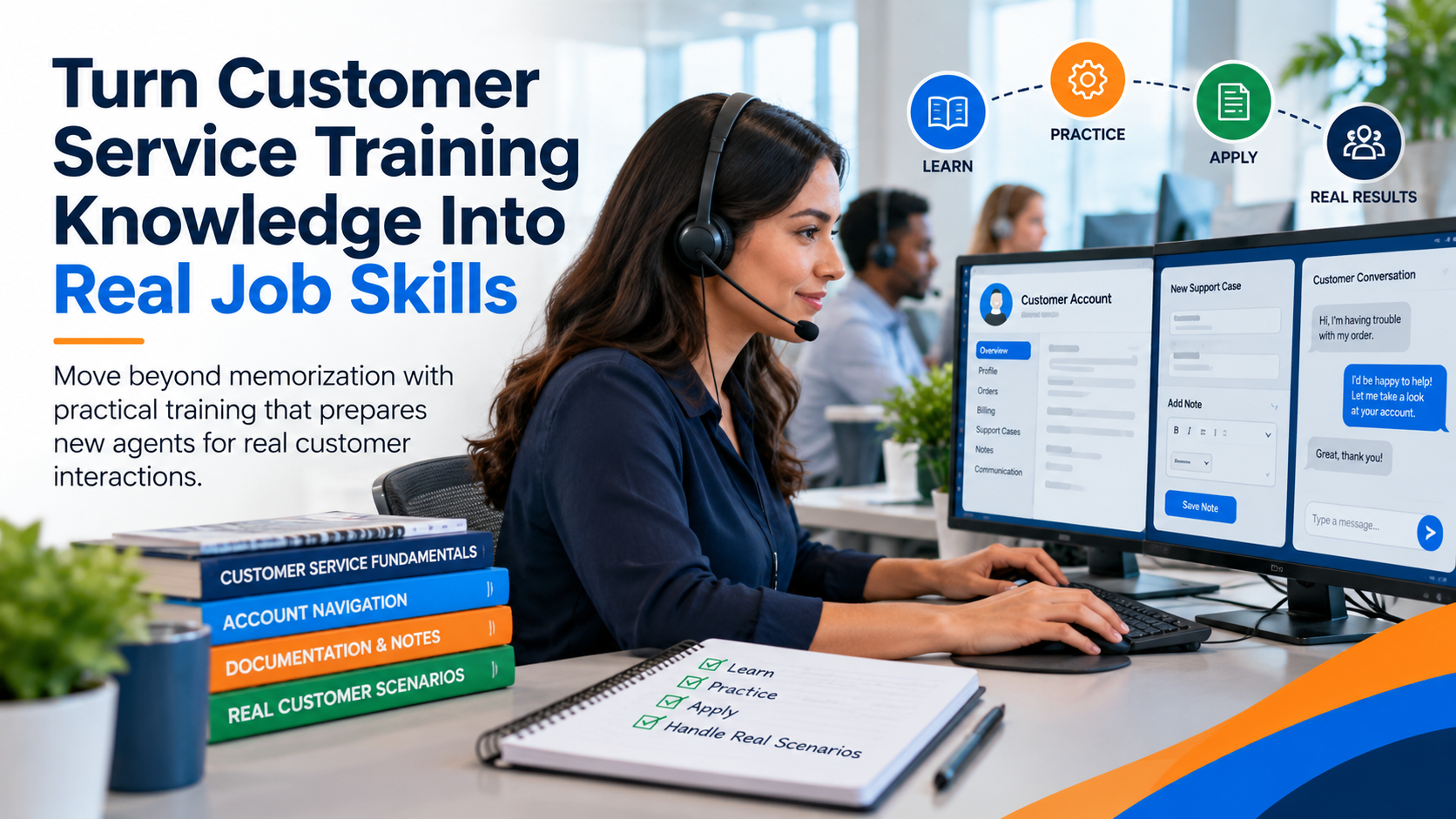
The nesting phase should reinforce new agents’ skills, not become the first time they try to put everything together.
Nesting is an important transition between formal training and independent production.
It gives new agents an opportunity to handle live interactions with additional supervision, coaching, and support.
But what happens when employees enter nesting without enough hands-on practice?
Supervisors may spend much of their time answering routine questions, helping agents navigate accounts, and correcting avoidable mistakes.
Instead of refining their skills, trainees may still be learning how to execute basic workflows.
The key is to begin preparing agents for nesting before their first supervised live interaction.
1. Identify the Skills Agents Will Need During Nesting
Start by reviewing the customer interactions new employees are most likely to handle.
Which systems will they use?
Which procedures must they follow?
What types of requests will they encounter?
Where do agents typically need assistance?
Use this information to establish a list of required skills.
For example:
- Customer identity verification.
- CRM account navigation.
- Knowledge-base research.
- Accurate workflow execution.
- Handling common customer concerns.
- Completing notes and call dispositions.
- Recognizing escalation requirements.
These skills should guide the practical exercises employees complete before nesting begins.
2. Build Practice Around Common Production Scenarios
Begin with realistic situations agents are likely to encounter regularly.
For example, a customer calls requesting an account status update.
The trainee must verify the customer, locate the appropriate account information, determine the current status, communicate the next steps, and document the interaction.
Once employees can complete common scenarios, introduce variations.
What if the customer has incomplete verification information?
What if the account contains conflicting records?
What if an additional task must be completed before the request can be resolved?
These variations help trainees develop flexibility while remaining within approved workflows.
3. Teach Resource Navigation Before Supervisors Become the Search Engine
One reason newly trained agents may rely heavily on supervisors is that they haven’t developed confidence using internal resources.
During practice, require trainees to locate information independently when appropriate.
Give them fictional requests that require searching the knowledge base, comparing account information, or identifying the relevant procedure.
Ask them to explain how they found the answer.
This builds a useful habit: research the approved resource, interpret the information, and take the appropriate action.
Of course, employees should always escalate when required by policy or when the situation exceeds their authority.
4. Make Documentation Part of Every Mock Call
Documentation shouldn’t be treated as an optional final step.
For each practice scenario, require trainees to document the customer concern, relevant findings, actions completed, final resolution, and required follow-up.
Then review the notes using consistent criteria.
Can another employee understand what happened?
Are the notes accurate and objective?
Do they reflect the actual work performed?
Good documentation practice prepares trainees for an important part of live customer service operations.
5. Conduct a Pre-Nesting Skills Assessment
Before trainees enter nesting, give them a scenario combining several of the workflows they’ve practiced.
Observe their performance and evaluate the required actions.
Use the results to identify skills that still need reinforcement.
An agent might be strong in communication but need additional navigation practice.
Another might understand the account workflow but need to improve documentation.
This information allows trainers to give nesting coaches more specific guidance.
Instead of simply saying “watch this agent closely,” trainers can identify the behaviors that deserve attention.
6. Use Nesting Feedback to Improve Future Training
Nesting can reveal patterns in the onboarding process.
If multiple agents struggle with the same task, investigate whether the training provides enough practice.
If agents repeatedly search for the same information, consider adding a resource-navigation exercise.
If documentation errors are common, include additional call wrap-up practice before nesting.
These insights can help improve the next training class.
Prepare Agents Before the Nesting Floor
Nesting is most valuable when agents arrive with foundational skills they can continue strengthening.
The goal isn’t to eliminate coaching or supervisor support.
It’s to reduce avoidable confusion and give coaches more opportunities to focus on higher-level performance.
The CSRSIM PRO Live-Call Readiness Toolkit helps trainers build that foundation with mock call templates, account navigation exercises, verification and documentation checklists, and structured performance scoring.
Explore the Live-Call Readiness Toolkit and give your next onboarding class more opportunities to practice before nesting begins.