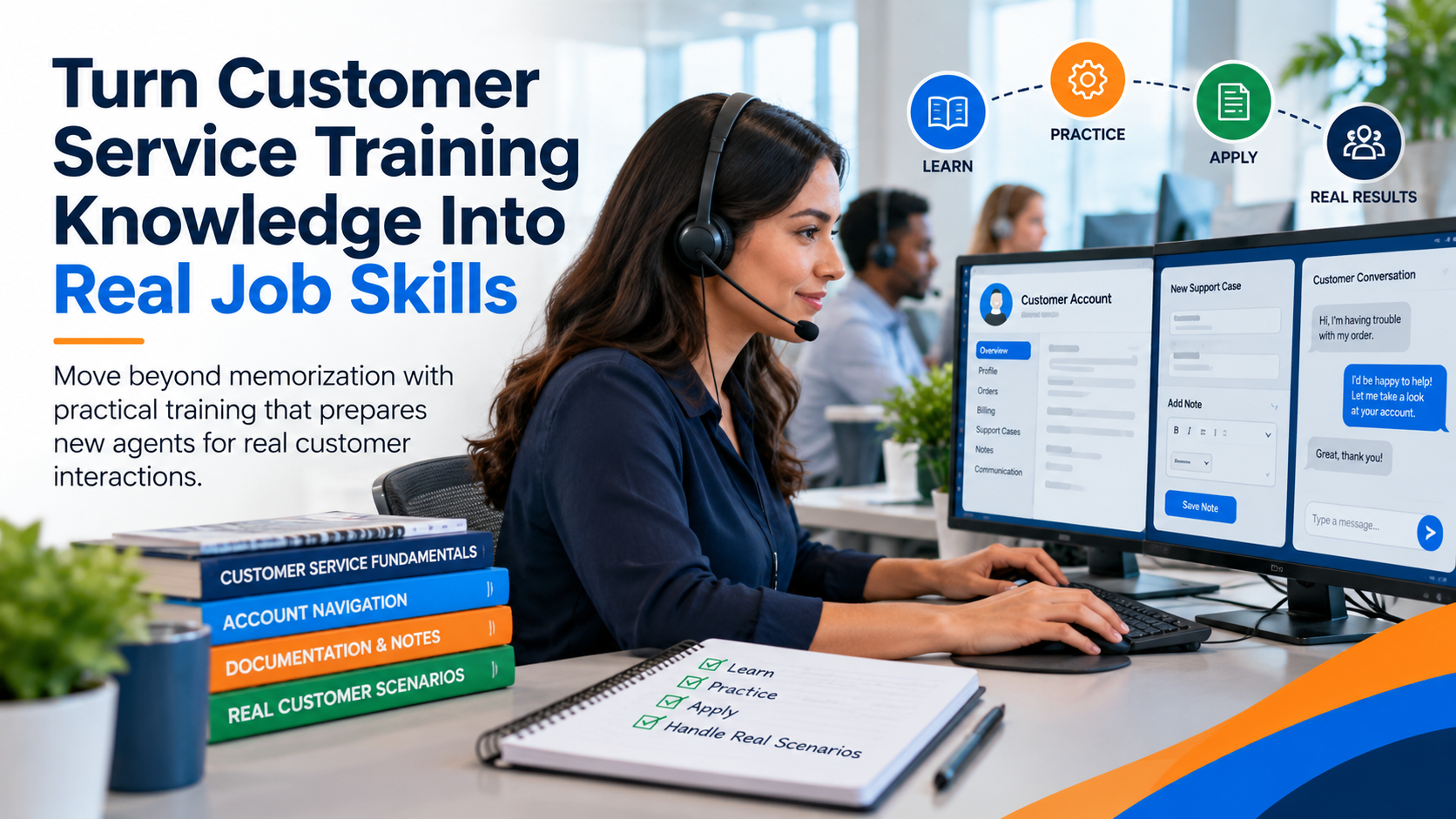
Your employees don’t need to know more just for the sake of knowing more. They need to be able to use what they’ve learned.
That’s where customer service training can become more effective.
Most onboarding programs already contain valuable information.
There are policies to follow, procedures to understand, systems to navigate, and customer communication standards to maintain.
But presenting that information is only part of preparing employees for their responsibilities.
The real question is:
Can trainees apply what they’ve learned when a customer needs an answer, a decision, or an account action?
Turning knowledge into practical skills requires a deliberate approach to training design.
Start With the Action, Not the Training Slide
Before creating another lesson, identify what employees need to do on the job.
For example, instead of starting with a presentation about customer account documentation, define the actual performance expectation.
“The agent must accurately document a customer interaction, including the reason for contact, actions completed, resolution, and required follow-up.”
Now the training objective is something observable.
The trainee either completes the documentation correctly or requires additional coaching.
Apply this approach to other customer service responsibilities.
Replace vague objectives like “understand account navigation” with more specific expectations such as “locate the correct customer record and identify the information required to resolve the request.”
Turn Existing Training Materials Into Practice Activities
You don’t need to discard your current training content.
Use it as the foundation for practical exercises.
If you’re teaching a policy
Create a fictional customer situation that requires the trainee to locate and apply the policy.
If you’re teaching CRM navigation
Create an account search challenge with specific information the trainee must find.
If you’re teaching a procedure
Build a mock scenario requiring the trainee to follow each step and complete the necessary action.
If you’re teaching call documentation
Present a completed fictional customer interaction and require the trainee to write accurate notes.
If you’re teaching customer communication
Pair the conversation exercise with account research and a required resolution.
Each activity connects information to an actual responsibility.
Make the Trainee Do the Work
There’s a difference between asking a trainee to explain a process and requiring them to perform it.
A trainer explains how to handle a customer requesting an update on an unresolved issue.
After reviewing the procedure, the trainee answers several knowledge questions correctly.
That’s useful, but the exercise can go further.
Provide a fictional customer account containing an unresolved request, previous interaction notes, and available reference materials.
Then ask the trainee to:
- Verify the customer.
- Locate the unresolved request.
- Review the previous interaction.
- Identify the correct next step.
- Complete the approved account action.
- Communicate the outcome.
- Document the interaction.
Now the trainee must combine several previously learned skills into one complete workflow.
Knowing the procedure isn’t the same as performing it.
Give new agents a fictional customer account, a specific task, and the responsibility to find the right information and complete the workflow.

Make them navigate, research, decide, and document.
The Account Navigation Practice Template helps you organize real-workflow exercises using required screens, search steps, decision points, and expected outcomes. Build the practice your trainees need before live calls.
Explore the Live-Call Readiness Toolkit →Introduce Realistic Challenges
Once trainees can complete a basic exercise, make the next scenario slightly more complex.
Include missing information, competing customer requests, or a situation requiring policy research.
This helps trainees practice responding when the answer isn’t immediately obvious.
The point isn’t to make training unnecessarily difficult.
It’s to help employees develop judgment, resourcefulness, and the ability to apply approved procedures in different situations.
Measure Skills With Clear Criteria
When evaluating practice, look beyond whether the trainee arrived at the final answer.
Review how they completed the task.
Did they follow the proper sequence?
Did they use the correct information?
Did they select an appropriate action?
Did they document the result accurately?
When performance falls short, identify the skill that needs improvement.
Then assign focused practice rather than repeating content the trainee already understands.
Build a Reusable Training Practice Library
One of the most practical improvements trainers can make is to organize exercises into a reusable library.
Start with five common customer situations.
For each one, define the objective, fictional customer information, required workflow, expected resolution, and evaluation criteria.
Create variations for different experience levels.
Over time, you’ll have a growing collection of structured practice activities that can be adapted for new onboarding classes.
The process becomes more consistent, and trainers spend less time rebuilding exercises from scratch.
Give Your Training Materials a Practical Purpose
Your procedures, slides, and training manuals already contain valuable knowledge.
The next opportunity is to create exercises that require employees to use that knowledge.
That’s where the CSRSIM PRO Live-Call Readiness Toolkit can help.
It includes reusable mock call scenario templates, customer verification resources, an account navigation practice template, documentation evaluation tools, a trainer scoring sheet, and an AI prompt pack for developing additional practice scenarios.
These resources help trainers move from planning what employees should know to designing activities that demonstrate what employees can do.
Get the Live-Call Readiness Toolkit and start turning your customer service training content into meaningful, measurable job practice.