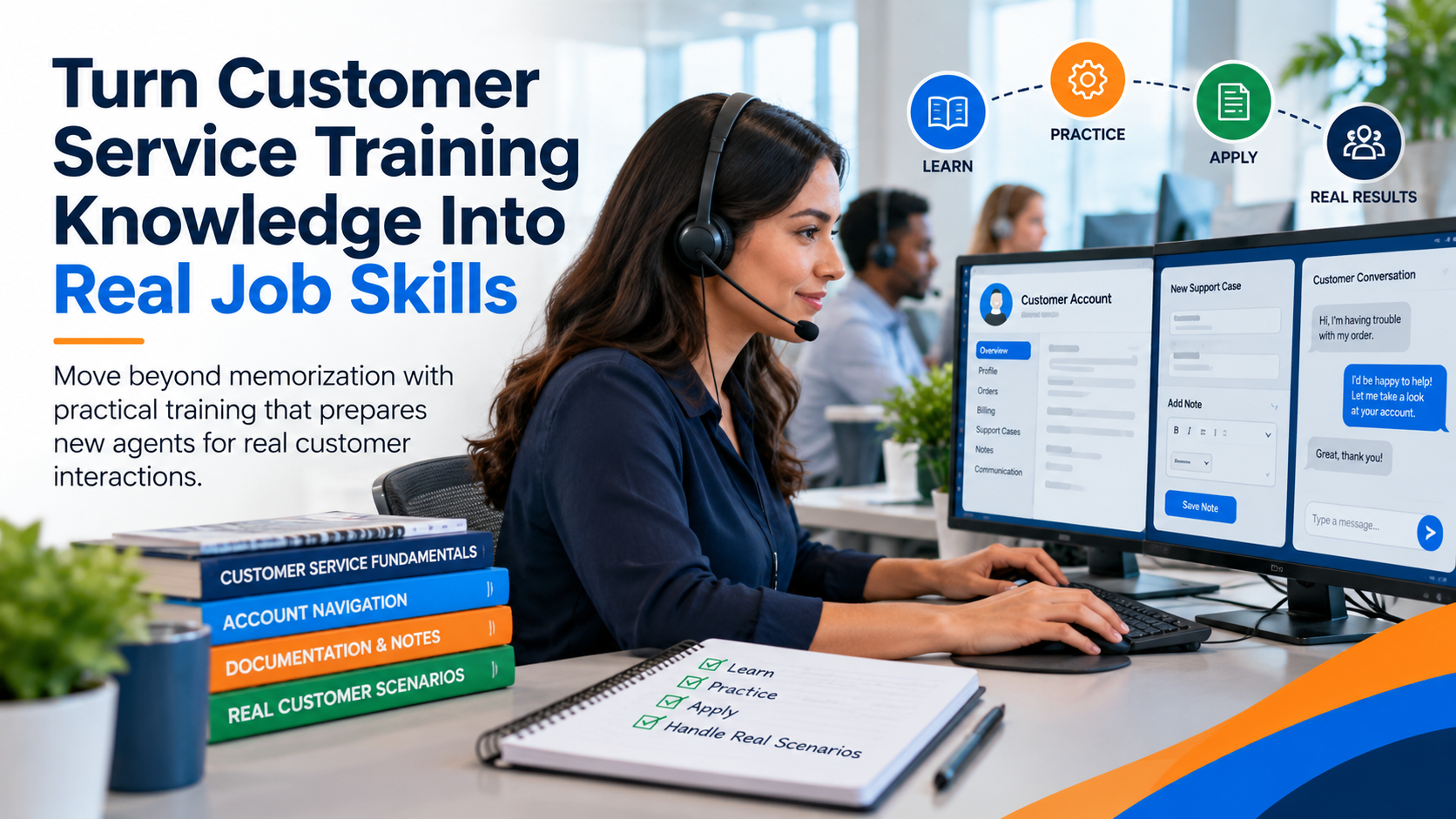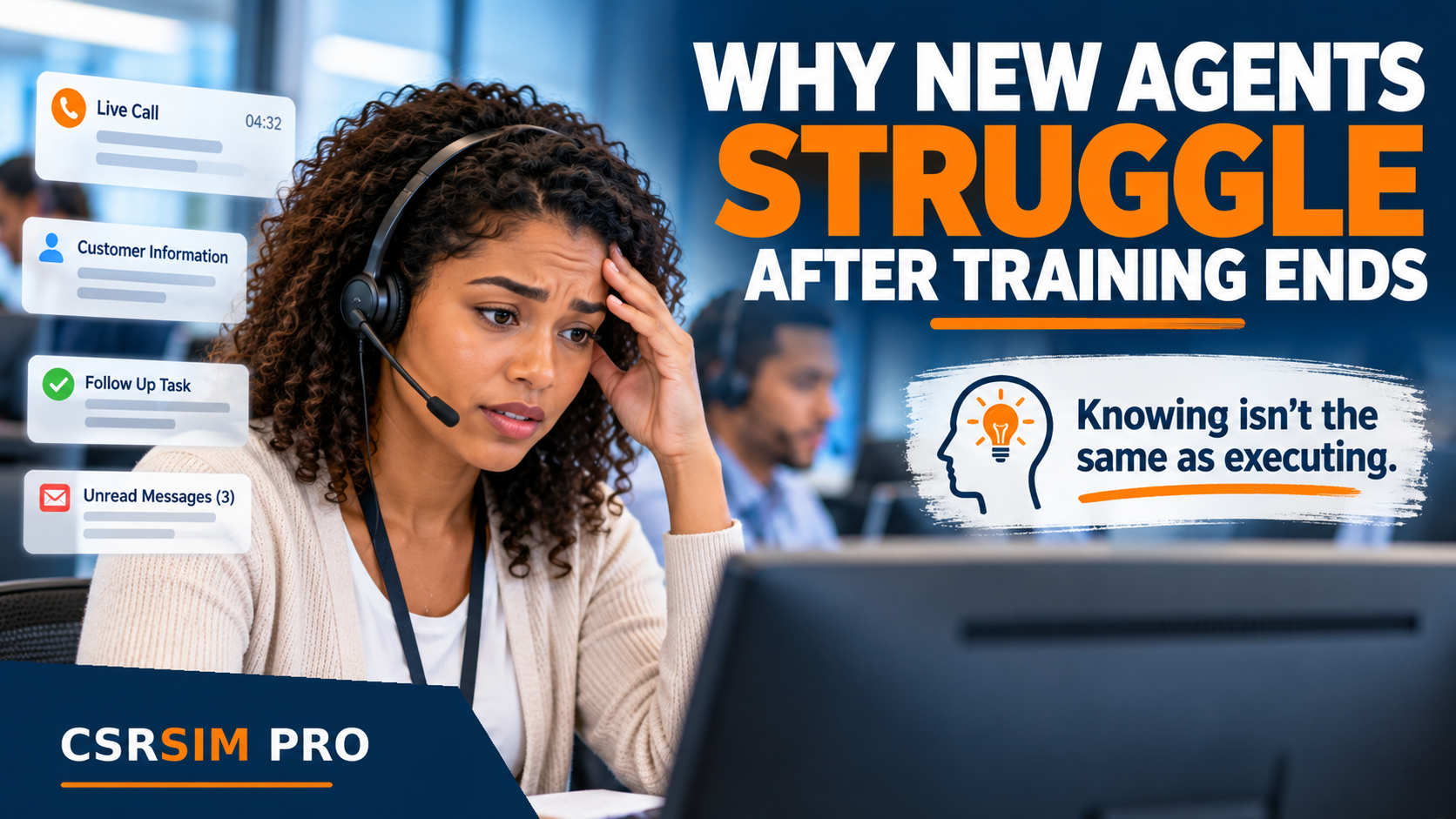
Your training program covered the material. Your new hires understood the procedures. Their assessment scores looked good.
But a few weeks into production, the same problems keep appearing.
Agents are taking longer than expected to navigate accounts. Supervisors are answering repeated questions. Call notes are missing important information. Some customer requests require unnecessary follow-up because the original interaction wasn’t fully resolved.
It’s tempting to conclude that the employees simply need more training.
But before scheduling another refresher course, it’s worth asking a different question:
Did the training actually require them to perform the tasks they’re now struggling with?
The Difference Between Knowing and Executing
Imagine a trainee who can explain your organization’s customer verification procedure perfectly.
They know which information is required and why.
During a live interaction, however, the customer begins explaining a complicated problem immediately.
The trainee becomes focused on resolving the issue and overlooks part of the verification process.
This doesn’t necessarily mean the trainee forgot the policy.
It may mean they haven’t practiced applying it while managing the other demands of a customer interaction.
Real customer service requires employees to combine several skills simultaneously.
And that combination is often where performance difficulties become visible.
Problem 1: Training Separates Skills That Production Combines
During onboarding, agents may learn verification in one lesson, CRM navigation in another, and call documentation in a third.
Each skill is practiced independently.
In production, employees must perform all three during the same interaction.
If training doesn’t include integrated practice, trainees may struggle to connect the steps.
Create mock calls requiring multiple skills.
For example, ask trainees to verify a fictional customer, research an account discrepancy, determine an appropriate action, and document the outcome.
Evaluate each part of the process.
Problem 2: The Training Scenarios Are Too Predictable
A scripted scenario can be helpful when employees are learning basic communication techniques.
However, if every practice call has an obvious answer and follows the same sequence, trainees may not develop the judgment needed for unfamiliar situations.
Training solution:
Introduce realistic complications.
Use incomplete account information, unexpected customer questions, and requests requiring multiple steps.
Make trainees identify what they need to know instead of supplying every piece of information upfront.
Problem 3: Agents Haven’t Practiced Finding Answers
A customer service agent isn’t expected to memorize every procedure.
They are expected to know how to access and use approved resources.
Yet some training programs emphasize presenting information more than practicing resource navigation.
Training solution:
Give trainees research tasks.
Ask them to locate the correct policy, identify which section applies to a fictional customer situation, and explain the action it requires.
Evaluate whether the trainee found and applied the correct information.
Problem 4: Coaching Focuses Too Heavily on Communication
Communication matters, but a professionally handled conversation can still result in an incorrect account action.
An agent may sound confident while overlooking important information or choosing the wrong resolution.
Include workflow accuracy in mock call scoring.
Evaluate verification, account research, decision-making, action completion, and documentation alongside communication skills.
This gives trainers a more complete view of performance.
Problem 5: Performance Gaps Aren’t Identified Until Production
Sometimes the first meaningful assessment of an agent’s independence happens during nesting or after go-live.
By that point, supervisors may already be managing avoidable questions and correcting workflow errors.
Training solution:
Introduce realistic skills assessments before production.
Define the required actions, observe performance, and give trainees additional targeted practice when needed.
Don’t Automatically Add More Training. Improve the Practice.
When agents struggle after onboarding, the solution isn’t always to repeat the same information.
First, identify where the workflow is breaking down.
Then ask whether your training process gives employees opportunities to perform that specific behavior.
A navigation problem needs navigation practice.
A research problem needs research practice.
A documentation problem needs documentation practice.
The goal is to help employees develop the skills their actual responsibilities demand.
Turn Training Gaps Into Practical Exercises
The CSRSIM PRO Live-Call Readiness Toolkit helps trainers create structured mock calls, realistic navigation exercises, documentation practice, and performance evaluations.
It provides reusable resources for translating operational problems into focused training activities instead of relying solely on additional presentations or refresher modules.
Get the Live-Call Readiness Toolkit and start building training around the real behaviors your agents need to demonstrate in production.